
Best Smart Ceiling Light Manufacturers in China
Choosing the Best Smart Ceiling Light Manufacturers in China requires more than comparing prices. A dependable supplier must combine optical engineering, stable electronics, intelligent controls, and consistent production quality. The strongest manufacturers usually offer complete development support, from light distribution testing to mobile app integration.
Dr. Mariana Figueiro, a respected lighting researcher, has stated, “Light is a powerful tool for regulating our circadian rhythms.” This principle matters in modern homes and commercial spaces. A well-designed Smart Ceiling Light should provide comfortable brightness, low flicker, adjustable color temperature, and reliable scheduling. It should not merely look futuristic.
China’s leading manufacturers often operate automated assembly lines, aging-test rooms, and photometric laboratories. During evaluation, buyers should inspect LED brands, driver efficiency, heat dissipation, Bluetooth or Wi-Fi stability, and compatibility with platforms such as Google Home or Amazon Alexa. Product samples deserve close attention. Check the diffuser surface, screw alignment, cable terminals, and app response time.
Certifications also reveal manufacturing discipline. Look for relevant CE, RoHS, FCC, or regional compliance documents, supported by traceable test reports. However, certificates alone cannot prove long-term reliability. That is where many comparisons become too optimistic.
Factory experience matters. Ask about annual capacity, warranty procedures, spare parts, customization limits, and previous export markets. A manufacturer may promise ten years of service, yet provide little evidence. That weakness should be stated clearly.
This guide examines reputable Chinese suppliers through product quality, engineering capability, smart-home compatibility, factory transparency, and after-sales support. The best choice is rarely the cheapest quotation. It is the manufacturer that can repeatedly deliver safe, comfortable, and genuinely intelligent lighting.
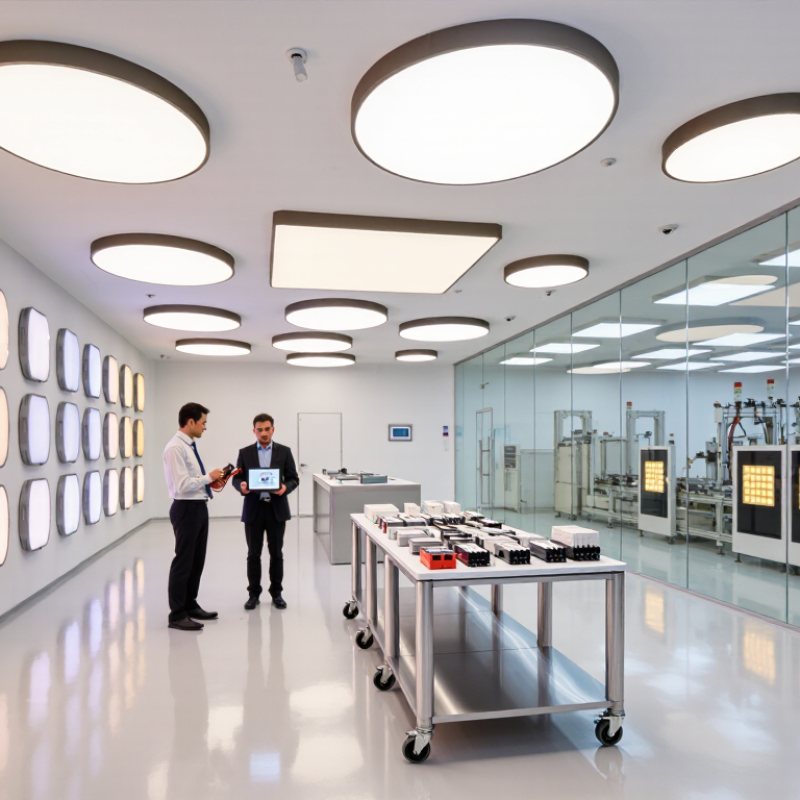
What Defines the Best Smart Ceiling Light Manufacturers in China
Best Smart Ceiling Light Manufacturers in China
The best smart ceiling light manufacturers in China combine practical engineering with dependable production control. Their products should offer stable wireless performance, safe heat management, and accurate brightness adjustment. A serious manufacturer explains these details clearly. Vague promises are not enough.
Experience matters during factory evaluation. Check how the team tests LED lifespan, driver temperature, dimming consistency, and repeated power cycles. Ask for samples from different production batches. One sample can look excellent. Real reliability appears over time. Manufacturers with trained engineers can also support app integration, voice control, scheduling, and compatibility with common smart-home systems. They should provide clear technical files, inspection records, and traceable quality procedures.
Tips: Request a working sample and test it for several weeks. Check light flicker with a phone camera, though this method is imperfect. Review installation instructions before placing a large order. Ask how defective units are handled, and confirm warranty terms in writing. Also, inspect packaging strength. A well-designed light can still arrive damaged. The strongest suppliers welcome reasonable questions and admit limitations instead of hiding them.
Best Smart Ceiling Light Manufacturers in China - What Defines the Best Smart Ceiling Light Manufacturers in China
| Evaluation Dimension | What High-Quality Manufacturers Should Demonstrate | Practical Benchmark or Requirement | Recommended Evidence |
|---|---|---|---|
| Product Safety Compliance | Products are designed and tested according to applicable luminaire safety requirements. | Testing aligned with IEC 60598-1 and the applicable part of the IEC 60598 series; China-market products may also require applicable CCC compliance. | Current test reports, certificates, technical files, and product markings. |
| Electrical and EMC Performance | Stable operation with appropriate electromagnetic compatibility controls. | EMC evaluation should address conducted and radiated disturbances, immunity, and lighting-equipment requirements such as CISPR 15 and IEC 61547 where applicable. | EMC test reports covering the exact model, driver, and wireless configuration. |
| Lighting Performance | Consistent brightness, color quality, and light distribution across production batches. | Published lumen output, wattage, beam or distribution data, CCT options, and color-rendering results measured under defined conditions. | Photometric reports, integrating-sphere results, and sample-to-sample comparison records. |
| Color Consistency | LEDs are controlled to minimize visible color variation. | A clearly specified color-tolerance target, such as a defined MacAdam ellipse level, with consistent binning and production controls. | LED binning records, color measurement reports, and incoming inspection procedures. |
| Thermal Management | The housing and internal design control LED and driver temperatures during continuous operation. | Thermal testing performed at the rated ambient temperature, with component temperatures remaining within supplier and safety limits. | Thermal test curves, maximum ambient rating, and validated driver specifications. |
| Reliability and Lifetime Claims | Lifetime statements are supported by recognized testing methods rather than unsupported marketing claims. | Use LM-80 data and TM-21 projections for LED packages where applicable, and state whether the rating refers to lumen maintenance, driver life, or the complete luminaire. | LM-80 reports, TM-21 calculations, accelerated-aging data, and warranty terms. |
| Smart Connectivity | The product supports stable pairing, control, firmware management, and recovery after power interruption. | Documented wireless protocol, operating range under stated conditions, control latency target, reset procedure, and offline behavior. | Connectivity test plans, user manuals, interoperability results, and firmware release records. |
| Application and Data Security | Connected products use controlled access, secure updates, and clear data-handling practices. | Unique credentials or secure onboarding, encrypted communications where supported, signed firmware updates, vulnerability handling, and a published privacy policy. | Security test summaries, update policy, privacy documentation, and incident-response contact. |
| Moisture and Environmental Protection | The enclosure is suitable for its declared installation environment. | An IP rating tested under IEC 60529 when protection against dust or water is claimed; the rating must match the intended indoor or covered outdoor application. | IP test report, installation restrictions, operating-temperature range, and material specifications. |
| Manufacturing Quality Control | Production controls cover incoming materials, assembly, programming, aging, and final inspection. | Traceable inspection procedures, documented sampling plans, functional testing for every finished unit, and controlled nonconformance handling. | Quality manual, inspection records, process-control plans, and factory audit results. |
| Customization Capability | The manufacturer can adapt mechanical, optical, electrical, packaging, and software requirements without weakening compliance. | Defined engineering workflow covering drawings, prototypes, design verification, pilot production, and change control. | Development schedule, engineering-change records, prototype reports, and sample approval documents. |
| Supply Capacity and Lead Time | Capacity claims are supported by equipment, staffing, component planning, and repeatable delivery performance. | A documented production capacity, component lead-time plan, safety-stock policy, and agreed on-time delivery target. | Capacity records, production schedules, delivery history, and business-continuity plans. |
| Warranty and After-Sales Support | Support processes address installation questions, firmware issues, replacement parts, and verified product failures. | Written warranty terms, defined response times, replacement procedures, spare-parts availability, and repair or failure-analysis processes. | Warranty policy, service-level agreement, troubleshooting guide, and customer-support records. |
| Export Documentation | Documentation is complete and matched to the exact product version and destination market. | Technical datasheet, installation manual, declaration or certificate where required, packaging labels, HS-code support, and shipment documentation. | Controlled document set, revision history, labeling samples, and pre-shipment checklist. |