
China Best Turnkey Cleanroom Solutions for Global Buyers

For global manufacturers, laboratories, hospitals, and electronics companies, a cleanroom is more than a sealed room with bright lights. It is a controlled production environment where air movement, pressure, temperature, humidity, and contamination risks must work together. China’s experienced engineering manufacturers now provide turnkey cleanroom solutions that connect planning, fabrication, equipment integration, installation, testing, and technical support.

A reliable project often begins with a practical site assessment. Engineers review building structure, process flow, personnel movement, material transfer, utility capacity, and future expansion needs. They may recommend sandwich panels, modular walls, air showers, pass boxes, HEPA filtration, monitoring systems, and customized HVAC units. Each component should support the required cleanliness classification and relevant standards, such as ISO 14644, while meeting local project requirements. Details matter.

The strongest Chinese suppliers combine factory manufacturing with on-site experience. They can provide layout drawings, airflow calculations, equipment schedules, commissioning records, and operator training. However, no supplier should promise identical results for every industry. A pharmaceutical facility, semiconductor line, and medical device workshop have different risks and validation expectations. Early designs may need revision after process data becomes clearer. That is normal. Transparent communication, documented testing, responsive service, and traceable materials help buyers make informed decisions. Global customers should compare technical depth, quality controls, project references, warranty terms, and after-sales capability, rather than judging only by price. With careful cooperation, a China-based cleanroom partner can deliver a safer, more efficient, and maintainable controlled environment from concept to operation.
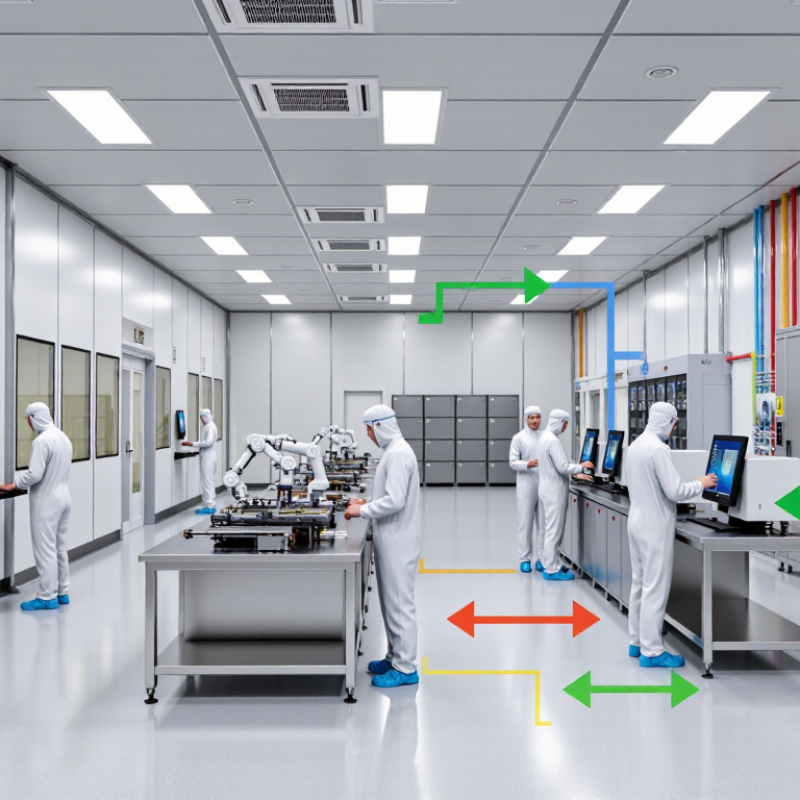
China Best Turnkey Cleanroom Solutions for Global Buyers

China Turnkey Cleanroom Solutions: Definition and Scope

China Best Turnkey Cleanroom Solutions for Global Buyers

China Turnkey Cleanroom Solutions: Definition and Scope

A turnkey cleanroom solution covers the complete path from concept to validated operation. It may include risk assessment, architectural design, HVAC, clean panels, flooring, utilities, monitoring, installation, testing, and operator training. The scope changes by industry. Pharmaceutical rooms need pressure cascades and contamination control. Electronics facilities may demand tighter particle limits and electrostatic protection. ISO 14644-1 defines airborne particle classes, but it does not replace process-specific risk assessment.

Market data supports this broader view. Grand View Research estimated the global cleanroom technology market at about USD 5.4 billion in 2023, with continued growth through 2030. Its analysis highlights pharmaceuticals, medical devices, and electronics as major demand sectors. A turnkey provider should therefore deliver measurable performance, not only attractive drawings. Commissioning records, HEPA filter integrity tests, airflow visualization, recovery tests, and calibrated monitoring data matter. Small gaps remain common. Utility loads are sometimes underestimated, and local maintenance skills may be overlooked.

Tips: Request a scope matrix before signing. Check ISO 14644 test methods, material certificates, software access, spare-part plans, and warranty limits. Ask how deviations are documented. A factory visit can reveal workmanship faster than a presentation. Buyers should also confirm local electrical codes, fire requirements, import conditions, and qualification responsibilities. The cheapest quotation can become expensive when validation, rework, or operator training is excluded. A practical solution is not perfect on paper; it remains controllable, serviceable, and evidence-based after handover.

Key Components of a Complete Cleanroom Project

China Best Turnkey Cleanroom Solutions for Global Buyers

A complete cleanroom project begins with risk mapping, not panel installation. The design team should define products, processes, personnel flow, and contamination sources. ISO 14644-1:2015 classifies rooms by airborne particles. For ISO Class 5, particles of 0.5 micrometres must remain below 3,520 per cubic metre.

Air handling is the project’s working core. It includes filtration, pressure control, temperature management, humidity control, and fresh-air balance. EU GMP Annex 1 (2022) requires continuous monitoring of critical environmental conditions in sterile operations. A reliable system therefore needs calibrated sensors, alarm records, and accessible maintenance points. Small details matter. Poorly sealed cable penetrations can weaken room performance.

The physical envelope should include cleanable wall panels, sealed ceilings, coved floors, doors, pass boxes, lighting, and process utilities. Commissioning must verify airflow, recovery time, HEPA filter integrity, pressure differentials, and particle counts. FDA’s Sterile Drug Products Guidance highlights environmental monitoring and validated aseptic controls as essential safeguards. In practice, documentation often receives less attention than equipment selection. That is a mistake. A missing calibration record can delay handover, even when the room looks perfect. Designs also need flexibility for future equipment, because fixed layouts can become expensive limitations.

China Best Turnkey Cleanroom Solutions for Global Buyers – Key Components of a Complete Cleanroom Project

A complete turnkey cleanroom project typically integrates the cleanroom enclosure, HVAC system, HEPA filtration, pressure control, monitoring, utilities, lighting, and validation. The chart below shows the maximum permitted concentration of airborne particles ≥0.5 µm per cubic metre for selected ISO cleanroom classes, based on ISO 14644-1.

Interpretation: Lower ISO numbers indicate stricter cleanliness requirements. The required classification directly influences airflow design, filtration efficiency, pressure cascade, monitoring systems, construction materials, and project validation procedures.

How Global Buyers Define Cleanroom Requirements

China Best Turnkey Cleanroom Solutions for Global Buyers

Global buyers define cleanroom requirements by process risk, not room appearance. ISO 14644-1 classifies air cleanliness through airborne particle concentration. It does not prove sterility or product quality. That distinction matters during specification reviews.

A pharmaceutical buyer may require Grade B background areas and Grade A critical zones under EU GMP Annex 1. An electronics facility may focus on particles at 0.1 micrometres, temperature stability, and electrostatic control. Food, medical, and laboratory projects need different hygiene evidence. One template cannot fit every application.

Budget pressure remains real. A 2024 cleanroom technology market analysis estimated global growth near 7% annually through the decade. This expansion reflects stricter manufacturing controls and wider demand for controlled environments. Buyers should request airflow calculations, recovery-time tests, filter certificates, pressure maps, and commissioning records. These documents reveal more than attractive renderings. Ask for operating costs, too. Energy can quietly dominate lifetime expenses.

Turnkey delivery should include design coordination, installation, validation support, and operator training. Yet “turnkey” is not automatically complete. Some proposals overlook gowning behavior, material transfer routes, or future equipment changes. That oversight can create expensive redesigns. Experienced buyers therefore define particle limits, pressure cascades, monitoring points, cleaning agents, local codes, and acceptance criteria before procurement. The specification may still change. That is normal. A transparent change log is more reliable than a perfect-looking promise.

China Best Turnkey Cleanroom Solutions for Global Buyers - How Global Buyers Define Cleanroom Requirements
Buyer Application Typical Cleanroom Target Maximum Particle Concentration at ≥0.5 µm Typical Room Pressure Strategy Typical Temperature & Relative Humidity Indicative Air Changes per Hour Common Filtration and Airflow Approach Key Buyer Acceptance Criteria
Sterile Pharmaceutical Filling ISO 5 Critical zone
Often aligned with EU GMP Grade A requirements
3,520 particles/m³ Positive pressure cascade, commonly 10–15 Pa between adjacent zones; final values are established by the contamination-control strategy. Usually 18–24°C
Common RH target: 40–60%
Approximately 240–600 ACH for unidirectional airflow zones; not prescribed by ISO 14644 alone. HEPA-filtered unidirectional airflow, low-turbulence return path, airlocks, and personnel/material segregation. Particle classification, airflow visualization, filter integrity, recovery time, temperature/RH mapping, and microbial-control procedures.
Pharmaceutical Compounding and Secondary Processing ISO 7 Background area for selected sterile operations
Often comparable to EU GMP Grade B at rest, depending on process design
352,000 particles/m³ Positive pressure relative to lower-grade surrounding areas; typically 10–15 Pa between adjacent rooms. Usually 18–24°C
Common RH target: 40–60%
Approximately 30–60 ACH as an initial design range; final selection depends on heat load and contamination risk. Terminal HEPA filtration, mixed or low-turbulence airflow, gowning rooms, pass-through cabinets, and pressure monitoring. ISO classification, pressure differential, recovery performance, HEPA integrity, cleaning compatibility, and environmental monitoring.
Medical Device Assembly ISO 7 For contamination-sensitive assembly and packaging 352,000 particles/m³ Positive pressure is common where protection from adjacent areas is required; pressure targets are project-specific. Typically 18–24°C
Common RH target: 40–60%
Approximately 30–60 ACH HEPA terminal filters, controlled material flow, cleanable wall systems, and dedicated gowning areas. Particle count, bioburden control where applicable, cleaning validation, material compatibility, and documented environmental conditions.
Electronics and Semiconductor Assembly ISO 5–7 Selected according to product sensitivity and process yield requirements ISO 5: 3,520 particles/m³
ISO 7: 352,000 particles/m³
Positive pressure to protect products from adjacent spaces; pressure cascade is coordinated with people and material movement. Commonly 20–24°C
RH often 40–55% to balance process stability and electrostatic risk
Approximately 30–600 ACH, depending on whether the area uses turbulent mixing or unidirectional airflow. HEPA or ULPA filtration, low-particle materials, controlled airflow, ESD grounding, and low-outgassing construction materials. Particle distribution, ESD performance, vibration limits, temperature/RH stability, airflow uniformity, and chemical contamination control.
Optics and Precision Instrument Assembly ISO 6–7 Selected according to optical surface sensitivity and assembly process ISO 6: 35,200 particles/m³
ISO 7: 352,000 particles/m³
Positive pressure with minimized turbulence and carefully controlled door opening and personnel movement. Commonly 20–23°C
RH often 40–55% for dimensional and surface-process stability
Approximately 30–90 ACH HEPA filtration, low-shedding finishes, stable airflow, anti-static measures, and localized clean benches where needed. Particle classification, vibration and illumination requirements, surface cleanliness, temperature stability, and operator gowning controls.
Food and Beverage High-Care Processing ISO 7–8 Cleanroom level depends on product exposure and shelf-life objectives ISO 7: 352,000 particles/m³
ISO 8: 3,520,000 particles/m³
Positive pressure is used in exposed-product zones; wet-process and odor-control areas may require dedicated exhaust systems. Commonly 15–22°C
RH is process-dependent and may require dehumidification
Approximately 15–40 ACH HEPA or high-efficiency filtration where required, hygienic drainage, washable surfaces, controlled personnel flow, and segregated raw materials. Hygienic zoning, microbial risk assessment, cleanability, condensation prevention, airflow direction, and sanitation procedures.
Healthcare and Protective Isolation Areas Application-specific Cleanliness classification is selected together with infection-control requirements Particle limits depend on the selected ISO classification; healthcare room design is not defined by particle count alone. Protective environments generally use positive pressure; airborne-infection isolation rooms generally use negative pressure. Commonly 20–24°C
RH target is determined by patient comfort, infection control, and building standards
Often approximately 6–12 ACH for specialized healthcare rooms; local healthcare codes and risk assessments govern final values. High-efficiency filtration, directional airflow, pressure monitoring, adequate exhaust, and validated room air distribution. Pressure direction, air-change rate, alarm response, filtration, noise, thermal comfort, and compliance with applicable healthcare regulations.
Research and Laboratory Facilities ISO 7–8 Or a process-specific classification based on research activities ISO 7: 352,000 particles/m³
ISO 8: 3,520,000 particles/m³
Pressure direction depends on the objective: positive for product protection, negative for hazardous containment. Commonly 18–24°C
RH often 40–60%, subject to equipment and experiment requirements
Approximately 10–30 ACH, with higher rates where exhaust or heat removal is needed HEPA supply or exhaust filtration where required, laboratory ventilation, zoning, interlocks, and independent monitoring. Containment level, exhaust performance, pressure stability, emergency operation, equipment heat load, and commissioning records.
Reference note: ISO 14644-1 defines airborne particle cleanliness classes, but it does not prescribe universal air-change rates, pressure differentials, temperature settings, or humidity values. Final requirements should be confirmed through the buyer’s process risk assessment, applicable national regulations, user requirement specification, and qualification plan.

Manufacturing, Installation, Validation, and Handover

China Best Turnkey Cleanroom Solutions for Global Buyers

A reliable cleanroom project begins with controlled manufacturing, not attractive drawings. Experienced teams define room classification, airflow patterns, pressure cascades, finishes, utilities, and equipment interfaces before production starts. Factory inspections should check panel joints, door seals, lighting, and material traceability. Small gaps can become expensive problems later.

Installation requires disciplined coordination. Technicians should protect finished surfaces, verify dimensions, and record every adjustment. Air handling units, filters, controls, and monitoring points must work as one system. Validation then confirms performance through documented tests, including particle counts, airflow checks, pressure readings, recovery time, and temperature control. ISO 14644 principles provide a useful technical reference. Real sites are rarely perfect. Late utility changes may still occur, so records must remain honest and current.

Tips: Request a clear validation plan before shipment. Review test methods with your quality team. Keep photographs, calibration certificates, drawings, and deviation reports together. During handover, operators should receive practical training, not only manuals. A supervised trial run often reveals weak procedures. Do not rush it. Reliable handover means the cleanroom can be operated, maintained, and audited with confidence from day one.

Quality Standards, Costs, and Supplier Selection Criteria

A turnkey cleanroom project in China should be judged by documented performance, not polished drawings. Buyers should request ISO 14644 classification reports, airflow test records, and calibration certificates. Quality also includes HEPA filter integrity, temperature control, humidity stability, pressure differentials, and cleanable surface materials. Ask whether testing occurs during factory acceptance and again after installation. Numbers matter.

Cost comparisons should include construction, filtration equipment, commissioning, staff training, spare parts, and future maintenance. The lowest quotation may exclude essential testing or site adjustments. Request an itemized bill of quantities, clear warranty terms, delivery milestones, and change-order rules. Supplier selection should consider similar project experience, engineering capacity, quality-control procedures, and after-sales response times. Review signed test reports, installation photographs, and references from comparable facilities. A supplier with strong documentation is usually safer than one offering only attractive pricing.

Tips: Define the required cleanliness class before requesting quotations. Check calibration traceability for measuring instruments. Ask who will supervise local installation. Confirm replacement filter availability and service access. Leave budget space for unforeseen modifications. Specifications can still be incomplete, even after several reviews. That is why independent validation remains valuable.

Update: We are here, we are shipping = bring extra natural light into your home during these difficult times.
Go to Top